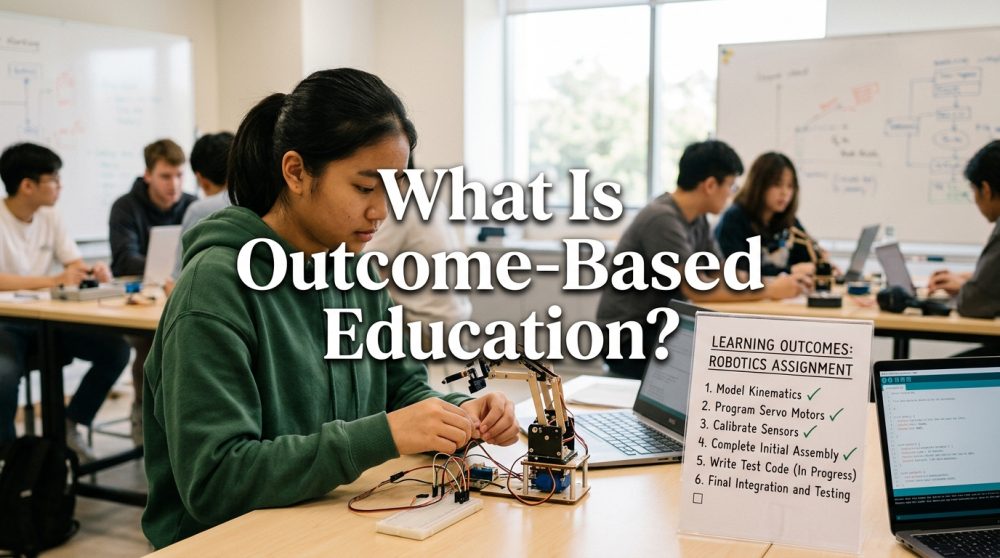
Outcome-Based Education (OBE) is a student-centered approach to teaching and learning that focuses on what students should know, understand, and be able to do by the end of a course or program. Instead of emphasizing the amount of content taught or the time spent in the classroom, OBE measures success based on the achievement of clearly defined learning outcomes.
Today, many schools, colleges, universities, and professional education programs around the world use Outcome-Based Education to improve learning quality, align education with workplace needs, and ensure graduates develop practical knowledge and skills.
In this comprehensive guide, you’ll learn what Outcome-Based Education is, its key principles, benefits, challenges, implementation process, and answers to frequently asked questions.
What Is Outcome-Based Education?
Outcome-Based Education (OBE) is an educational model that organizes curriculum, teaching methods, learning activities, and assessments around specific learning outcomes.
A learning outcome describes what a student should be able to demonstrate after completing a lesson, course, or degree program.
Rather than asking:
“What did the teacher cover?”
OBE asks:
“What can the student actually do after learning?”
This shift places student achievement at the center of the educational process.
What Are Learning Outcomes?
Learning outcomes are clear statements describing the knowledge, skills, attitudes, or competencies students are expected to achieve.
Examples include:
- Explain the principles of supply and demand.
- Solve algebraic equations accurately.
- Design a basic computer program.
- Conduct a scientific experiment safely.
- Communicate effectively in professional settings.
- Demonstrate ethical decision-making in business.
Good learning outcomes are measurable and observable.
Key Principles of Outcome-Based Education
Outcome-Based Education is built on several core principles.
1. Clear Learning Outcomes
Every course begins by defining exactly what students should achieve by the end of instruction.
These outcomes guide teaching, learning, and assessment.
2. Student-Centered Learning
OBE focuses on helping students achieve the desired outcomes rather than simply delivering lectures.
Students actively participate through:
- Discussions
- Projects
- Practical exercises
- Group work
- Problem-solving activities
- Independent learning
3. Alignment
Everything in the educational process should support the intended outcomes, including:
- Curriculum
- Lesson plans
- Teaching strategies
- Learning resources
- Classroom activities
- Assessments
This is often called constructive alignment.
4. Continuous Assessment
Instead of relying only on final examinations, OBE uses multiple assessment methods to evaluate learning throughout the course.
Examples include:
- Quizzes
- Assignments
- Presentations
- Portfolios
- Practical demonstrations
- Projects
- Peer assessments
5. Continuous Improvement
Institutions regularly review student performance data to improve courses, teaching methods, and curriculum design.
Feedback from students, employers, faculty members, and accreditation bodies often contributes to these improvements.
Goals of Outcome-Based Education
The main objectives of OBE include:
- Improving student learning.
- Developing practical skills.
- Promoting critical thinking.
- Encouraging lifelong learning.
- Preparing graduates for employment.
- Ensuring educational accountability.
- Meeting industry and professional standards.
Characteristics of Outcome-Based Education
OBE typically includes the following features:
- Clearly stated learning outcomes.
- Student-centered teaching.
- Skills-based learning.
- Competency-focused assessments.
- Flexible teaching methods.
- Continuous evaluation.
- Evidence-based improvement.
- Real-world application of knowledge.
Benefits of Outcome-Based Education
Better Learning Outcomes
Students understand exactly what they are expected to achieve, making learning more focused and purposeful.
Improved Employability
OBE emphasizes practical competencies that employers value, such as communication, teamwork, critical thinking, and problem-solving.
Greater Accountability
Teachers and institutions can measure whether students have achieved the intended learning outcomes and identify areas for improvement.
Enhanced Student Engagement
Active learning strategies encourage students to participate more fully in the learning process.
Flexibility in Teaching
Educators can use a variety of teaching methods as long as they help students achieve the required outcomes.
Easier Curriculum Evaluation
Clear outcomes make it easier to review and improve educational programs over time.
Challenges of Outcome-Based Education
Despite its advantages, implementing OBE can present challenges.
Time-Consuming Planning
Developing measurable learning outcomes and aligning assessments requires careful preparation.
Assessment Difficulties
Some outcomes, such as leadership or ethical reasoning, can be difficult to measure consistently.
Faculty Training Needs
Teachers may require professional development to design effective outcomes, assessments, and active learning activities.
Resource Requirements
Successful implementation may require updated technology, teaching materials, and institutional support.
Resistance to Change
Students and educators accustomed to traditional lecture-based instruction may need time to adapt to the OBE approach.
Outcome-Based Education vs. Traditional Education
| Outcome-Based Education | Traditional Education |
|---|---|
| Focuses on student outcomes | Focuses on content delivery |
| Student-centered | Teacher-centered |
| Measures competencies and skills | Measures knowledge recall primarily |
| Uses continuous assessment | Often relies heavily on final exams |
| Flexible teaching methods | More standardized teaching methods |
| Learning outcomes guide curriculum | Curriculum often guides instruction without explicit outcome alignment |
How Outcome-Based Education Works
A typical OBE process follows these steps:
Step 1: Define Learning Outcomes
Educators identify the knowledge and skills students should demonstrate after completing the course.
Step 2: Design the Curriculum
Course content and learning activities are organized to support those outcomes.
Step 3: Choose Teaching Strategies
Instructors select methods such as lectures, discussions, case studies, simulations, laboratory work, or projects.
Step 4: Assess Student Learning
Students complete assessments that directly measure whether they have achieved the intended outcomes.
Step 5: Evaluate and Improve
Assessment results are analyzed to improve future teaching and curriculum design.
Examples of Outcome-Based Education
Example 1: Nursing Program
Learning Outcome:
Students will safely perform basic patient care procedures.
Assessment:
Clinical demonstrations and supervised practical examinations.
Example 2: Engineering Course
Learning Outcome:
Students will design a bridge capable of meeting specified engineering requirements.
Assessment:
Design project and technical presentation.
Example 3: Business Program
Learning Outcome:
Students will prepare and present a complete business plan.
Assessment:
Business proposal, presentation, and financial analysis.
Where Is Outcome-Based Education Used?
Outcome-Based Education is widely used in:
- Universities
- Colleges
- Technical institutes
- Medical schools
- Engineering programs
- Nursing education
- Teacher education
- Vocational training
- Professional certification programs
Many accreditation agencies encourage or require institutions to demonstrate that graduates achieve clearly defined learning outcomes.
Tips for Successfully Implementing Outcome-Based Education
Educators can strengthen OBE by:
- Writing clear and measurable learning outcomes.
- Aligning assessments with outcomes.
- Using active learning strategies.
- Providing regular feedback to students.
- Reviewing assessment data to improve teaching.
- Collaborating with employers and industry professionals when designing programs.
Frequently Asked Questions
What is Outcome-Based Education?
Outcome-Based Education is a teaching approach that focuses on the knowledge, skills, and competencies students should demonstrate after completing a course or program.
What are learning outcomes?
Learning outcomes are measurable statements describing what students should know, understand, or be able to do after instruction.
Why is Outcome-Based Education important?
OBE helps ensure students gain practical skills, supports continuous improvement in education, and better prepares graduates for employment and further study.
Is Outcome-Based Education better than traditional education?
Neither approach is universally better. OBE emphasizes measurable student achievement and practical competencies, while traditional education often focuses more on delivering subject content. Many institutions combine elements of both approaches.
What is the main goal of Outcome-Based Education?
The primary goal is to ensure every student achieves clearly defined learning outcomes through aligned teaching, learning activities, and assessments.
Final Thoughts
Outcome-Based Education (OBE) shifts the focus of education from what teachers teach to what students actually learn and can demonstrate. By defining clear learning outcomes, aligning curriculum and assessments, and emphasizing continuous improvement, OBE helps students develop the knowledge, skills, and competencies needed for academic success, professional careers, and lifelong learning. As education continues to evolve, Outcome-Based Education remains a valuable framework for creating meaningful, measurable, and learner-centered educational experiences.