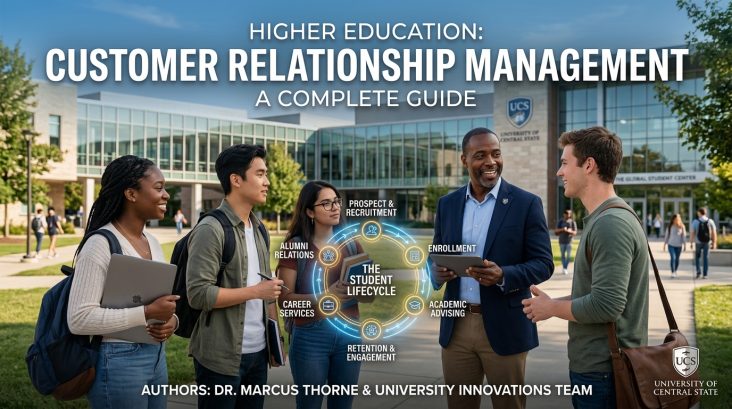
Customer relationship management (CRM) in higher education is the use of technology, data, and organized communication to manage relationships between a university or college and its students, prospective students, alumni, parents, and other stakeholders.
Although the term customer can feel unusual in education, universities increasingly use CRM systems to understand student needs, improve communication, support enrollment, and build stronger long-term relationships.
A good higher education CRM does more than store contact information. It brings together information about a student’s interactions with the institution and helps staff provide more timely and personalized support.
What Is CRM in Higher Education?
In higher education, CRM refers to the strategies and software institutions use to manage relationships throughout the student journey.
This journey can begin when someone first visits a university website and continue through:
Prospective student → Applicant → Admitted student → Enrolled student → Graduate → Alumni
A CRM can help an institution keep track of interactions at each stage.
For example, a prospective student might download a university prospectus. The CRM can record that interaction and allow the admissions team to send relevant information about application deadlines, programs, scholarships, and campus visits.
Why Is CRM Important in Higher Education?
Universities communicate with thousands of people every year. Without a centralized system, important information can become scattered across email accounts, spreadsheets, databases, and different departments.
A CRM can help institutions:
- Organize student information
- Improve communication
- Manage prospective students
- Increase enrollment
- Support current students
- Track applications
- Improve student engagement
- Manage alumni relationships
- Automate repetitive tasks
- Make decisions using data
The goal is not simply to collect more data. The goal is to use information to create better experiences and make better decisions.
How Does a Higher Education CRM Work?
A university CRM typically collects information from multiple interactions and organizes it in one system.
For example, a prospective student may:
- Visit the university website.
- Request information about a course.
- Attend a virtual open day.
- Speak with an admissions officer.
- Start an application.
- Submit documents.
- Receive an admission offer.
- Enroll.
A CRM can help staff see these interactions as part of one relationship rather than treating each interaction as a separate event.
Common Uses of CRM in Higher Education
1. Student Recruitment
One of the most common uses of CRM technology is student recruitment.
Universities can use CRM systems to manage prospective students from their first interaction through enrollment.
Staff can track:
- Program interests
- Applications
- Communications
- Events attended
- Application status
- Follow-up activities
This can make recruitment more organized and targeted.
2. Admissions Management
A CRM can help admissions teams manage large numbers of applicants.
For example, staff can use automated workflows to remind applicants about:
- Missing documents
- Application deadlines
- Interviews
- Financial aid
- Admission decisions
- Enrollment requirements
This reduces the risk of applicants missing important information.
3. Student Engagement
CRM systems can also be used after students enroll.
Universities can communicate with students about:
- Academic support
- Campus events
- Student organizations
- Important deadlines
- Career services
- Financial assistance
- Advising appointments
Personalized communication can make students feel more connected to their institution.
4. Student Retention
CRM data can help institutions identify students who may need additional support.
For example, an institution might identify patterns involving:
- Missed appointments
- Poor engagement
- Unanswered communications
- Academic difficulties
- Financial concerns
The CRM itself does not solve these problems, but it can help staff identify where intervention may be appropriate.
5. Alumni Relations
The relationship between a university and a student doesn’t necessarily end at graduation.
CRM systems can help institutions maintain relationships with alumni by managing:
- Alumni contact information
- Events
- Donations
- Newsletters
- Career networking
- Volunteer opportunities
- Fundraising campaigns
A strong alumni relationship can benefit both the institution and its graduates.
Benefits of CRM in Higher Education
Better Communication
A CRM can help universities send the right information to the right people at the right time.
More Personalized Experiences
Instead of sending every student the same message, institutions can segment audiences based on interests, programs, application status, or other appropriate information.
Improved Efficiency
Automation can reduce repetitive administrative tasks and allow staff to spend more time on activities requiring human interaction.
Better Data Management
A centralized CRM can reduce fragmented information and make it easier for authorized staff to access relevant records.
Improved Enrollment Management
Admissions teams can identify where prospective students are in the recruitment process and determine where additional communication may be needed.
Stronger Alumni Relationships
Institutions can maintain relationships with graduates long after they leave campus.
Challenges of CRM in Higher Education
CRM implementation isn’t always easy.
Data Quality
If information is outdated, duplicated, or incomplete, the CRM may produce unreliable results.
Privacy and Security
Universities handle sensitive personal and academic information. They need strong security measures and appropriate access controls.
Staff Adoption
A CRM only works well when employees actually use it correctly. Training and clear processes are therefore essential.
Integration
A university may already use separate systems for admissions, student records, learning management, finance, email, and other functions. Integrating these systems can be complicated.
Cost
CRM software can involve significant expenses, including implementation, customization, training, maintenance, and ongoing licensing.
CRM vs Student Information System
These systems can overlap, but they generally serve different purposes.
| CRM | Student Information System |
|---|---|
| Focuses heavily on relationships and engagement | Focuses heavily on student records |
| Recruitment and admissions | Enrollment and academic records |
| Communication | Grades and courses |
| Marketing | Registration |
| Prospective students | Current student administration |
| Alumni engagement | Official student information |
Many universities use both systems and connect them so information can flow between platforms.
Examples of CRM Activities in a University
Imagine a student is interested in studying computer science.
The university could use its CRM to:
- Record the student’s request for information.
- Send information about the computer science program.
- Invite the student to an open day.
- Remind them about application deadlines.
- Track their application.
- Send enrollment information after admission.
- Continue communicating with them after enrollment.
The CRM helps the institution manage the relationship throughout the journey.
Best Practices for Higher Education CRM
For a CRM strategy to succeed, universities should:
- Define clear objectives.
Decide whether the priority is recruitment, retention, engagement, alumni relations, or another goal. - Keep data accurate.
Establish processes for updating and cleaning records. - Train staff.
Employees should understand both the technology and the institution’s CRM processes. - Personalize communication.
Avoid sending irrelevant messages simply because the system makes mass communication easy. - Protect student information.
Establish appropriate security, privacy, and access controls. - Integrate important systems.
Where appropriate, connect the CRM with admissions, student information, learning, marketing, and communication platforms. - Measure results.
Track meaningful outcomes such as engagement, application conversion, enrollment, retention, and alumni participation.
Frequently Asked Questions
What is customer relationship management in higher education?
It is the use of CRM strategies and technology to manage and improve relationships between educational institutions and prospective students, current students, alumni, and other stakeholders.
Why do universities use CRM systems?
Universities use CRM systems to improve communication, manage recruitment and admissions, personalize student engagement, support retention, and maintain alumni relationships.
Is a student information system the same as a CRM?
No. A student information system generally focuses on official academic and administrative records, while a CRM focuses more heavily on communication, engagement, recruitment, and relationships.
Can CRM improve student retention?
It can support retention by helping institutions identify engagement patterns and coordinate timely communication and support. However, CRM software alone cannot guarantee that students will remain enrolled.
What is the main goal of CRM in higher education?
The central goal is to build stronger, more informed relationships throughout the student lifecycle while helping the institution communicate and operate more effectively.
Conclusion
Customer relationship management in higher education is becoming an important part of how colleges and universities manage the student lifecycle. From attracting prospective students to supporting enrolled students and maintaining relationships with alumni, CRM systems can bring communication, data, and engagement activities together.
However, successful CRM is about more than purchasing software. Institutions need accurate data, trained staff, clear objectives, appropriate privacy practices, and a genuine focus on the needs of students and other stakeholders.
When these elements work together, CRM can help universities move from fragmented communication toward a more connected, personalized, and student-centered educational experience.